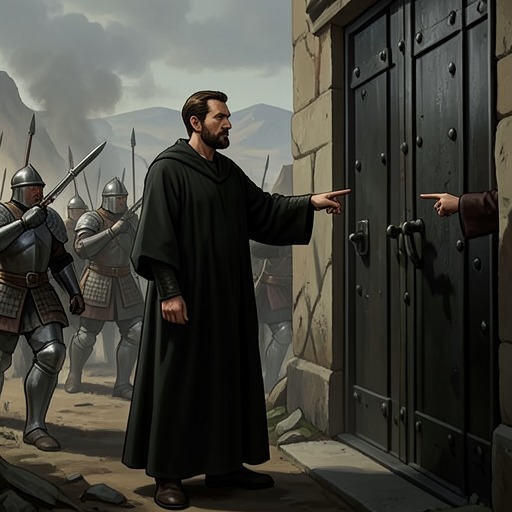
Sun Hao
The Romance of the Three KingdomsSun Hao is the last ruler of Wu in the account of the Three Kingdoms’ collapse and reunification. His accession follows a dispute over succession, and his rule turns on a sharp contrast: he claims imperial authority while alienating his people through executions, heavy exactions, and a costly ambition to conquer in the north. When Jin ultimately takes Wu’s last-stand city, he abandons the thought of suicide and surrenders, bringing the three kingdoms’ division to an end.
Accession and Succession
After Sun Xiu dies, unable to speak, he indicates that his heir, Sun Wan, should be supported. Once the late emperor’s choice is announced, however, leading military officers object that Sun Wan is too young to lead in a moment of danger. They demand Sun Hao, son of Sun He, as their ruler. Sun Wan is assigned a small region to govern, and Sun Hao is proclaimed emperor in AD 265.
The succession establishes Sun Hao through the military officers’ preference rather than the deceased ruler’s expressed choice. In the narrative’s wider account of dynastic change, the transfer of power does not secure Wu against the pressures that will bring it down; his reign instead exposes the consequences of a ruler’s estrangement from officials and people.
Rule and Political Decline
The account says Sun Hao soon reveals a cruel and violent nature. He elevates the eunuch Cen Hun as his companion, and when Puyang Xing, the late emperor’s prime minister, and others protest, Sun Hao has them executed arbitrarily. Their deaths silence opposition: after this, no one dares to complain or resist.
His government also weighs heavily on the population. Oppressive measures and exceptionally high taxes bring widespread poverty; the court seizes private funds and family fortunes as well as demanding revenue through taxation. Lü Kai, Sun Hao’s own deputy prime minister, warns that the people are poor despite the absence of disaster, the treasury is empty despite the lack of public works, and Wu has less than a year’s supplies. He points to officials demanding what people cannot provide and to the harem’s growth from fewer than one hundred women under Sun Quan to more than a thousand. His petition calls for reduced demands for military service, labor, and other obligations, a smaller palace household, and better appointments. Sun Hao does not respond with restraint: he becomes more extravagant and builds vast palaces.
Ambition Against Jin
A fortune-teller tells Sun Hao that a blue canopy will one day enter Luoyang. Sun Hao interprets the prediction as a sign that Wu will conquer Jin. Rather than treating the prophecy as a warning or an uncertainty, he lets it feed his desire for a northern campaign. Advice from people who understand the situation does not dissuade him, and preparations begin for an invasion, with Xiangyang selected as the first target and Lu Kang placed in command of Wu’s forces.
The proposed campaign brings Wu’s internal weakness into direct contact with Jin’s calculations. Jia Chong tells Sima Yan that Sun Hao is deeply unpopular among his own people and argues that a Jin invasion could be seen as virtuous and might help trigger a coup, allowing Wu to fall easily. The contrast is pointed: Sun Hao imagines conquest on the strength of an interpreted omen, while his opponents assess the vulnerability his rule has created at home.
Surrender and the End of Wu
As Jin’s conquest approaches its conclusion, a great storm brings down the remaining Wu soldiers’ and sailors’ banners. Many take the falling banners as an inauspicious sign and desert, leaving only a few brigades between Jin and victory. Wang Jun advances toward Shitou, determined to capture the city. Zhang Xiang’s surrender helps open its gates: after the defenders see that he has changed sides, they admit him and the Jin army.
Sun Hao recognizes that resistance is over and initially considers suicide. He is persuaded instead to follow the precedent of Liu Shan and surrender to Jin. Wang Jun accepts his surrender and treats him as an honored guest, as a prince. His personal end is therefore a surrender rather than a death in battle; politically, it marks the final fall of Wu and the unification of the Three Kingdoms into one.
Narrative Significance
Sun Hao’s career gives the account’s recurring pattern of dynastic rise and collapse a final political instance. The opening historical frame attributes the Han’s breakdown to failed rulers and a court captured by the Ten Imperial Attendants; later scenes likewise make food, public hardship, and the conduct of officials consequential to state survival. In Sun Hao’s case, the explicit warnings about poverty, depleted supplies, and unpopular officials are set against his executions, extraction of wealth, and palace extravagance. The account links these failures to the conditions that make Wu vulnerable to Jin, while his misreading of the fortune-teller’s prediction supplies an ironic counterpoint to the kingdom’s actual end.